- October 10, 2026
- capitalpowertechbd
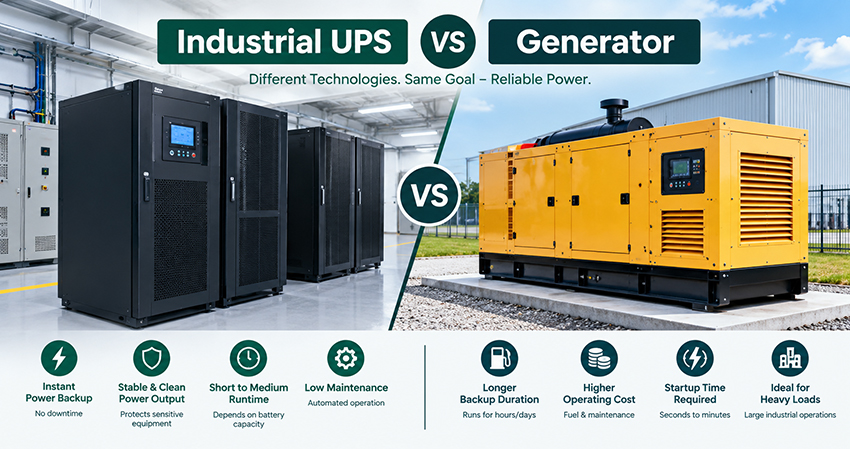
The core challenge is that an industrial UPS can provide power with virtually zero interruption, while a generator needs time to start, stabilize, and take over the load. That is why the choice between Industrial UPS vs Generator depends on how quickly power must return, how long the backup must last, and which equipment cannot tolerate even a short interruption.
When a factory loses grid power, the real question is not simply whether you need backup electricity. An industrial UPS can keep sensitive equipment running during the transition, while a generator can supply continuous backup power for extended outages. This disparity is critical for factories in Bangladesh, which may depend on motors, control systems, automation equipment, servers, and other electrically sensitive loads. The description of UPS systems by the U.S. Department of Energy characterises a UPS as a system that provides the continuity of load power when the input supply is lost.
Understanding The Difference Between An Industrial UPS And A Generator
An industrial UPS primarily solves power interruptions. When utility power fails or becomes unstable, its stored energy can immediately support connected equipment. This is particularly useful for control systems, automation equipment, communication systems, servers, and other loads where a sudden shutdown can interrupt a process or cause equipment problems.
A generator solves a different problem: duration. A standby generator uses an engine and alternator to produce electricity when the primary grid supply becomes unavailable. With a suitable automatic transfer switch, the generator can take over selected factory loads and continue operating as long as fuel and maintenance conditions allow.
This distinction is also why factories may need both. NIST documentation on critical facilities shows how UPS systems and generator/automatic-transfer arrangements can work together rather than being treated as competing technologies.
Industrial UPS Vs Generator: A Practical Comparison
When An Industrial UPS Makes More Sense
An industrial UPS is usually the stronger choice when even a brief power interruption can create an operational problem. Consider a factory with automated controls, PLCs, monitoring equipment, networking hardware, or other sensitive electronics. A momentary power loss may stop a process, even if the generator starts shortly afterward.
In this situation, the UPS’s value is not simply the energy stored in its batteries. Its main value is the time it provides and the continuity it maintains while the factory responds to the outage.
Factories evaluating this option can also review Capital PowerTech’s UPS System solutions to understand better how UPS systems fit into industrial power protection.
When A Generator Makes More Sense
A generator becomes more practical when the factory needs to operate substantial loads for an extended outage. Production machinery, ventilation, selected HVAC systems, lighting, pumps, and other larger electrical loads may require considerably more sustained energy than a conventional battery system can economically provide.
However, generators require proper installation, fuel management, ventilation, testing, and maintenance. The U.S. Department of Energy notes that standby generators normally use an automatic transfer switch to move the load from the utility supply to the generator during an outage.
For factories specifically considering generator capacity, reviewing a dedicated Generator Supplier in Bangladesh can help separate equipment selection from the wider electrical-system design.
Why The Best Answer May Be Both
The best way to understand Industrial UPS versus Generator is not to view them as competing backup systems, but as two technologies that can work together in succession. Each solves a different part of the power-continuity problem, and using them together can provide a more complete backup strategy for industrial facilities.
The UPS responds immediately when the main power supply fails. It provides uninterrupted power to critical equipment during the first few seconds or minutes, preventing sensitive systems from shutting down or losing their processes. At the same time, the generator starts, reaches operating speed, and prepares to take over the longer-duration load.
Once the generator is ready, the power arrangement can transition from the UPS to generator supply. This allows the generator to provide backup power for an extended period without leaving sensitive equipment exposed to the interruption that occurs during generator startup.
This is the key distinction: UPS provides continuity, while the generator provides endurance. The UPS protects the critical gap between power failure and generator availability; the generator then supports the facility for as long as fuel and operating conditions allow. Together, they create a layered backup system rather than forcing the factory to depend on either technology alone.
The same principle can extend to the factory’s wider electrical infrastructure. If the facility depends on high-voltage distribution, reviewing its Electrical Substation Service can be important because backup power is only as reliable as the electrical system connecting it to critical loads.
How To Choose The Right System For Your Factory
Instead of starting with equipment specifications, start with the consequences of an outage. Use the following decision framework:
- Step 1: Identify the consequences.
- Step 2: Classify the loads.
- Step 3: Determine the required backup duration.
- Step 4: Evaluate restart requirements.
- Step 5: Match each load with the appropriate backup system.
First, identify which machines must remain operational, which systems can shut down safely, and whether restarting production creates significant cost, safety, or process complications. If even a short interruption can damage equipment, interrupt a critical process, or cause expensive downtime, those loads should receive priority protection.
Next, separate the factory’s electrical loads into critical and non-critical categories. Critical electronic and control loads may require UPS protection because they cannot tolerate an interruption during generator startup. Larger production loads that can tolerate a short transfer period may be assigned to generator backup.
Then determine how long backup power is actually required. If outages are brief, UPS capacity may cover critical loads for the required period. If outages can continue for hours, a generator may be necessary for sustained operation. Where both immediate continuity and long-duration backup are required, a UPS + generator configuration can provide both.
The decision should also include safety and installation requirements. OSHA’s generator safety guidance stresses proper transfer-switch installation, grounding, ventilation, and prevention of generator overloads.
Finally, review resilience and redundancy across the wider electrical system. The International Energy Agency’s review of electrical reliability emphasises reliability planning because power outages can disrupt electricity-dependent processes. This framework helps factories move from simply comparing equipment to selecting a backup strategy based on consequence, load type, outage duration, and operational risk.
Final Verdict
There is no clear winner in Industrial UPS vs Generator. If your priority is preventing short interruptions from affecting sensitive equipment, an industrial UPS is usually the better fit. If your priority is keeping larger factory loads running through a prolonged outage, a generator is generally more appropriate.
For many factories, the most sensible approach is not choosing one over the other. A properly designed UPS + generator system can provide immediate continuity followed by long-duration backup.