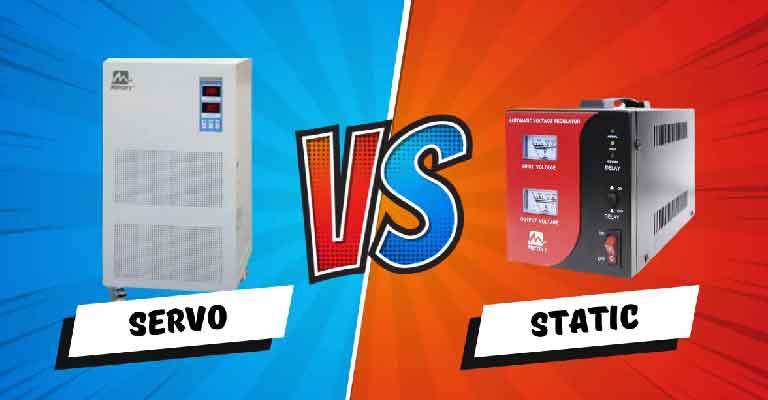
If you run a factory floor, a hospital department, a server room, or even a small office in Bangladesh, one thing should be clear from the start: choosing the wrong stabilizer will shorten the lifespan of your equipment. You have probably dealt with the same headache, voltage that refuses to stay consistent. One hour, it drops into brownouts; the next hour, you face sudden power surges, and in between, constant fluctuations slowly wear down expensive systems.
That is exactly why people search for “AVR” and “stabilizer” solutions. But here is the part that often gets confusing. Two of the most common options are servo voltage regulators (servo-controlled AVRs) and static stabilizers (static voltage regulators). They both aim to deliver stable output voltage, but they do it in very different ways, and those differences matter a lot depending on your load.
Let’s break it down in a practical way.
What a Servo Voltage Regulator Actually Does
A servo voltage regulator uses an electromechanical system to correct voltage. Inside, you will typically find a variac or transformer with motor-driven brushes. When input voltage changes, a control circuit tells the servo motor to move the brush to the correct position, bringing the output back to the desired level.
Because it is continuously adjusting, a servo regulator is well known for high accuracy and smooth correction. One of its key advantages is step-less correction, meaning it regulates voltage without abrupt jumps or discrete steps, ensuring a seamless and stable output. This is why it is widely used for sensitive and high-value loads in Bangladesh, especially in industrial and medical environments. Servo AVRs commonly come in dry-type and oil-type designs. In tougher applications, oil-cooled units help with heat management and long duty cycles, while dry-type units are often chosen for cleaner indoor setups.
What a Static Stabilizer Does
A static stabilizer regulates voltage without moving parts. Instead of servo motors and brushes, it uses power electronics (like thyristors/IGBT-based switching, depending on design) and control circuits to correct voltage quickly. Because there is no mechanical movement, static stabilizers are typically faster in response and require less maintenance related to wear and tear.
A key advantage here is millisecond correction time, meaning the stabilizer can respond almost instantly to voltage fluctuations. This ultra-fast response is the main reason static stabilizers are considered ideal for server environments, where even a brief disturbance can affect performance or cause system instability.
In real-world use, static stabilizers are often selected for places where speed, reliability, and minimal servicing are important, such as IT infrastructure, server rooms, and data centers.
Key Differences That Actually Matter
The easiest way to think about it is this: servo stabilizers are “precision mechanical correction,” while static stabilizers are “fast electronic correction.” Here are the main differences people in Bangladesh usually care about when buying.
- Regulation method: Servo uses motor-driven brushes; static uses electronic switching.
- Response speed: Static is usually faster; servo is fast enough for most use cases, but not as instant as static.
- Accuracy and smoothness: Servo systems are widely preferred where very fine, stable regulation is needed.
- Maintenance: Servo units may need brush and mechanical servicing over time; static units have fewer moving-wear parts.
- Suitability by load type: Servo often shines in heavy industrial and precision equipment; static is excellent for IT and critical electronic environments.
Where Servo Voltage Regulators Fit Best in Bangladesh
In Bangladesh, servo-controlled AVRs are commonly used where equipment is expensive, loads are heavy, and fluctuations are wide. Think of industries where one voltage sag can ruin production or where precision matters more than anything.
Servo regulators are a strong fit for:
Industrial factories and machinery, where voltage regulators protect CNC machines, automated assembly lines, and plant equipment from spikes and sags. Many factories also deal with high start-up currents, and robust servo solutions are often chosen for that kind of load behavior.
Textile and manufacturing plants, including garment factories, are where wide voltage swings are common. Many operations prefer customized industrial AVR solutions with full installation management because a one-size-fits-all stabilizer often underperforms in real conditions.
Medical and diagnostic equipment, where accuracy is non-negotiable. Hospitals using imaging and diagnostic tools often choose high-precision servo regulators to protect equipment like MRI and CT scanners and other sensitive systems.
Servo AVRs in Bangladesh are commonly installed across a wide capacity range. Smaller units like 5 kVA to 10 kVA are popular for homes, labs, clinics, and small offices. On the industrial side, three-phase voltage stabilizers from 20 kVA to 500 kVA are common, and large factories may go for 100 kVA systems or even 500 kVA industrial AVR configurations depending on the load.
Where Static Stabilizers Make More Sense
Static stabilizers are a smart choice where you want rapid correction and minimal mechanical maintenance, especially for electronic infrastructure that needs steady voltage and quick reaction to fluctuations.
They are widely used in:
Hospitals and data centers, where static stabilizers protect servers, network equipment, storage systems, and complex IT infrastructure that can be sensitive to both spikes and dips.
Server rooms and commercial IT environments, where even small disturbances can cause downtime, device stress, or data risks.
Commercial buildings, where stabilizers are integrated with LT panels to protect lifts, HVAC systems, and other building services that run continuously.
Choosing the Right One: A Simple Buying Approach
Instead of getting stuck on the word “best,” focus on the load and the site conditions. In Bangladesh, the right stabilizer choice is usually based on three things: voltage fluctuation range, load type (motor vs electronics), and capacity.
If you want a quick checklist, use this logic: If you run heavy machinery, textile equipment, or precision medical tools, a servo voltage regulator is often the safer pick because of its stable output and fine regulation.
If you run IT loads, servers, and critical electronic systems, a static stabilizer often fits better because it is fast and has fewer wear components.
Also, make sure you select the right phase type. Single-phase is common for small offices, labs, and smaller equipment. Three-phase is the standard for industrial plants, elevators, and large commercial buildings.
Finally, consider future expansion planning. A common mistake is sizing the stabilizer only for the current load. In practice, you should select a unit with at least 20–30% higher capacity than your present requirement. This ensures the system can handle load growth without overloading the stabilizer, improving both performance and long-term reliability.
Installation, Safety, and After-Sales: The Part People Regret Ignoring
Even the best voltage regulator can fail early if it is installed incorrectly or sized incorrectly. This is why professional suppliers in Bangladesh typically do a proper load assessment, check generator compatibility, and ensure protection features like overload and short-circuit safety.
Good systems also include practical features such as a bypass switch, clear metering or digital displays, and genuine electronic components that meet regulations. In the long run, reliable maintenance and real spare parts matter just as much as the initial price.
Why Many Buyers in Bangladesh Choose Capital PowerTech
In Bangladesh, Capital Powertech is known as a leading AVR importer and supplier, providing solutions designed to keep machinery protected from voltage spikes, sags, and unstable utility supply. They supply advanced servo control AVRs (dry/oil-type) built with high-quality components, and they also provide static voltage regulators and relay-type stabilizers depending on application needs.
What makes their approach practical is that they do not just sell a box. They offer full turnkey support, including delivery, installation, commissioning, and after-sales service. Their team provides personalized technical guidance, accurate installation, and ongoing maintenance and repair services to keep systems running without interruptions. They also supply genuine AVR systems from recognized brands such as SAKO, Mingch, Delta, Ortea, Impress Corporation, Green Power, and AB Power Engineering.
They have also handled power transfer-related projects, including successful Automatic Transfer Switch (ATS) installations and supply support for multiple ATS setups in Dhaka, which matters if you are managing generator changeover along with voltage regulation.
Final Words (and a Simple Next Step)
Servo voltage regulators and static stabilizers both solve the same problem, but they solve it in different ways. If you match the technology to your load and get the sizing and installation right, you can protect your equipment, reduce downtime, and avoid costly failures. The right team can assess your load, recommend the right regulator type, share an itemized quotation/BOQ, and handle installation plus long-term after-sales support for Bangladesh conditions.